Yila
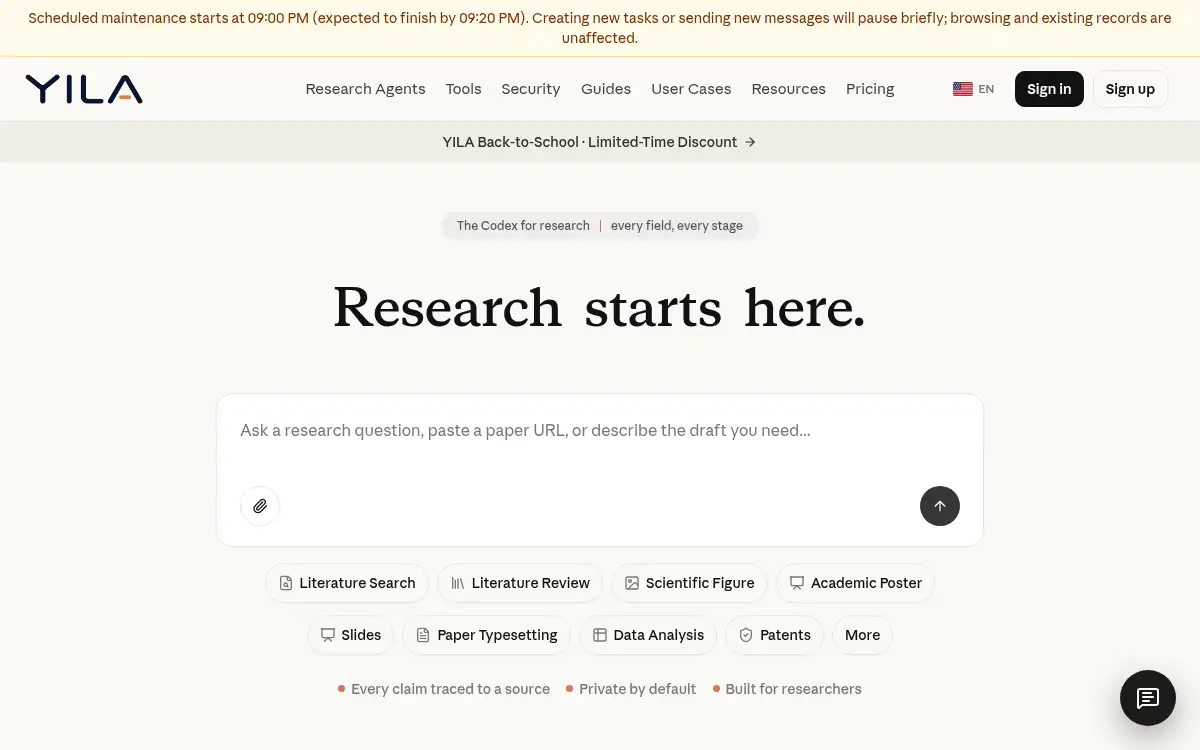
Open SiteYila is an evidence-traceable research workspace with agents for literature search, PDF reading, data analysis, scientific figures, posters, and paper-to-slides with citations.
Added on November 6, 2026
Product Information
What is Yila?
Yila AI is a research workspace and agent suite for academic and scientific work. It helps with literature search across sources such as OpenAlex, PubMed, arXiv, and Wanfang, paper triage, cited literature reviews, bilingual reading, evidence cards and matrices, section writing, journal polish, data analysis with reusable code and charts, scientific figures, academic posters, and editable slide decks. Claims stay traceable to sources, and outputs are private by default and editable. It is built for students, researchers, and labs that need end-to-end research drafting with evidence links—not a generic chatbot.
How to use Yila?
- 1. Open yila.ai and sign in to the research workspace
- 2. Pick an agent for your task—literature search, review, PDF chat, data analysis, figures, poster, or slides
- 3. Provide a topic, paper, notes, or dataset as the agent requires
- 4. Review cited drafts, annotated reading, charts, or presentation outputs
- 5. Edit privately and export the section, figure, poster, or PPTX for lab meetings or submissions
Core Features
- • Literature research agents — Gap check, multi-database search, triage, and cited reviews
- • Evidence-traceable reading — Paper evidence cards, evidence matrix, bilingual line-by-line reading
- • Writing support — Section drafting, journal polish, and template-aware typesetting
- • Data analysis — Research design, upload-and-analyze workflows, stats write-ups with reusable code/charts
- • Presentation pack — Scientific figures from prompts, academic posters from papers, editable PPTX slides
- • PDF tools — Chat with PDF answers that point back to the page; citation generator for many styles
- • Private-by-default outputs — Editable research artifacts aimed at labs and thesis workflows
Use Cases
- • Graduate students drafting a cited literature review from dozens of papers
- • Labs turning notes and papers into meeting decks or thesis-opening slides
- • Researchers building an evidence matrix across competing studies
- • Analysts uploading data for automated checks, charts, and written stats results
- • Authors polishing prose toward a target journal template before submission