ThunderPhone
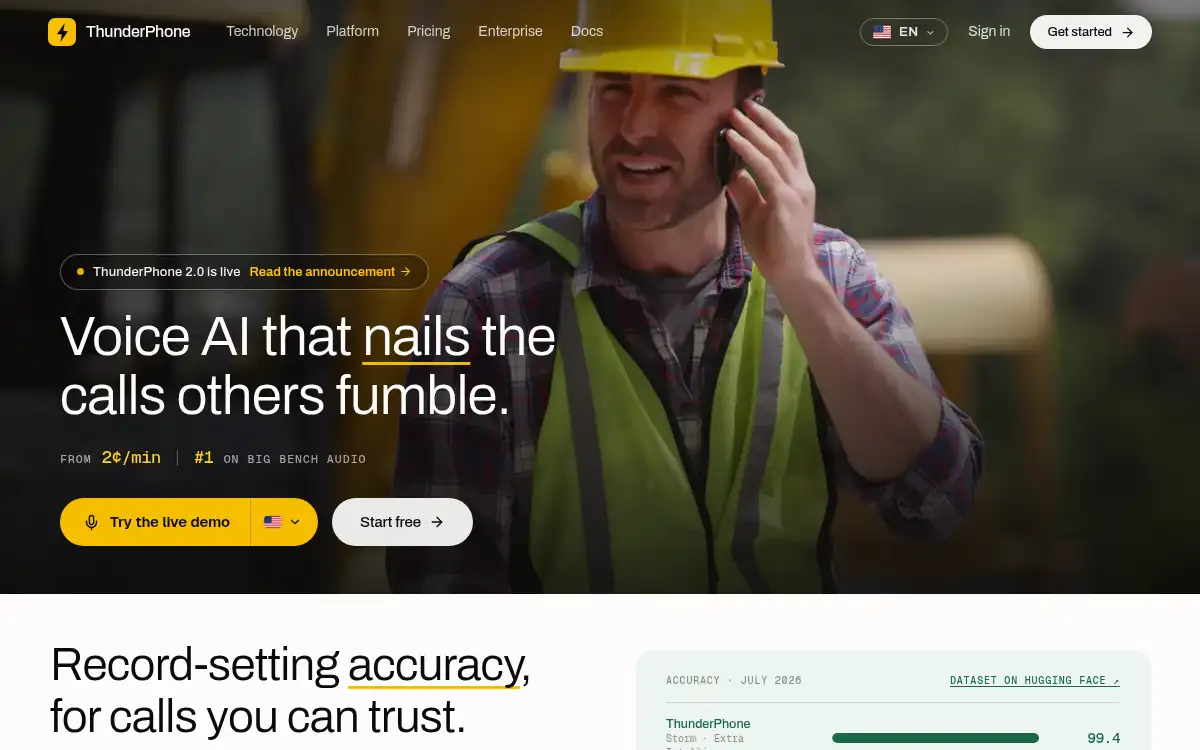
Open SiteThunderPhone is a self-serve platform for building, testing, monitoring, and deploying reliable AI phone agents across real phone calls and 47 languages.
Added on September 10, 2026
Product Information
What is ThunderPhone?
ThunderPhone is voice AI infrastructure for teams that need phone agents to handle real customer calls reliably. It combines speech recognition, language models, testing simulations, live monitoring, and issue detection into one self-serve platform. The product emphasizes accuracy on difficult phone audio, transparent pricing from low per-minute rates, and multilingual support. It is aimed at builders and operators who want production-ready phone agents for support, scheduling, sales, parts lookup, and similar call-heavy workflows.
How to use ThunderPhone?
- Create a ThunderPhone account from the official website.
- Build an AI phone agent by configuring its voice, knowledge, behavior, and task flow.
- Test the agent with AI-caller simulations before sending real calls to it.
- Deploy the agent on a real phone number for customer or operational calls.
- Monitor live calls, review detected issues, and approve proposed fixes to improve reliability.
Core Features
- AI phone agent builder - Provides a self-serve way to create agents for real telephone calls.
- Multi-model audio stack - Uses multiple transcription and reasoning signals to reduce misheard names, addresses, and part numbers.
- Caller simulations - Tests agents before production calls reach real users.
- Live call monitoring - Lets teams watch calls and intervene or review when needed.
- Automatic issue detection - Finds production call problems and suggests improvements.
- Multilingual support - Handles calls across 47 languages, including mid-call language switching.
- Usage-based pricing - Starts from low per-minute rates with models included.
Use Cases
- Customer support calls - Answer common service requests without hiring a large call center.
- Scheduling workflows - Let callers book, change, or confirm appointments by phone.
- Parts and operations lookup - Understand noisy field calls and retrieve accurate inventory or job information.
- Voice-agent QA - Simulate, monitor, and improve phone agents before and after launch.